Designed at Every Layer
The Shelf
Pick a vibe
Software doesn't have to look like software. Browse by the aesthetic that fits your day. Every app on Potchkey lives inside one of these worlds.
Your life should be seeing beauty every single day.
Most software is boring, rote, and looks like every other program. We think that's a tragedy of small moments. The tools you touch a hundred times a day should give something back. Potchkey is a home for the makers who agree, and the people who want to live with what they make.
Made for the web
Not everything needs to be an app. These are real products built on Potchkey that live on a web page — open a link and use them, no download, no app store, no install. Some things are simply better as a website.

Website or app?
Building something? Here's a quick gut-check on which one it wants to be.
Lean website
When friction is the enemy and reach is the point.
- People use it now and then — no reason to make them install anything.
- A link is the front door. Shareable, searchable, embeddable, opens instantly.
- It should work everywhere — any device, any OS, nothing to download.
- Updates ship instantly — you publish, everyone has it on refresh.
- It's a tool used in short bursts — planning, browsing, forms, calculators, content.
- You're a small maker who'd rather skip app-store review, fees, and native builds.
Lean app
When it lives on the home screen and digs into the device.
- People reach for it daily and want an icon on the home screen.
- It needs deep device features — camera, GPS, sensors, background tasks.
- Push notifications matter for the core experience.
- It must work fully offline or lean on heavy local data.
- Performance is critical — games, pro creative tools, heavy graphics.
- You want store distribution, discovery, and in-app purchases.
In between? A web page can be installed to the home screen and work offline with notifications (a "progressive web app") — often the best of both for makers, and a great place to start.
About

Design with design.
Most of us are at our computers all day, so why should we be staring at something that dulls the mind? We want the neurons in our brain firing, stimulating better thoughts and ideas, and bringing out our own creativity.
Potchkey Labs is a marketplace for software with a point of view. We started it because the apps we open every day cause cognitive friction, both in terms of function and in terms of design. We hope that what we create gives you some dopamine hits, contributes to your salon wall in your mind, and sparks invention.
We built a shelf for the other kind: apps made by people who care how a button feels, whether a workflow actually saves you time, whether opening the thing puts you in a better mood than before. Functional, and also doing something interesting for you.
This is the beginning. We're starting to tinker with things we've wanted to put out into the world for a while. What's exciting about AI right now is that it turns everyone into a tinkerer, a creator — more to come soon. Hopefully it inspires you to make something too.







Potchkey Labs
Vibe Coding 101
You don't need to be an engineer to build something useful. Vibe coding is building by describing what you want, looking at what comes back, and nudging it until it works the way you imagined.
Helpful Tips 
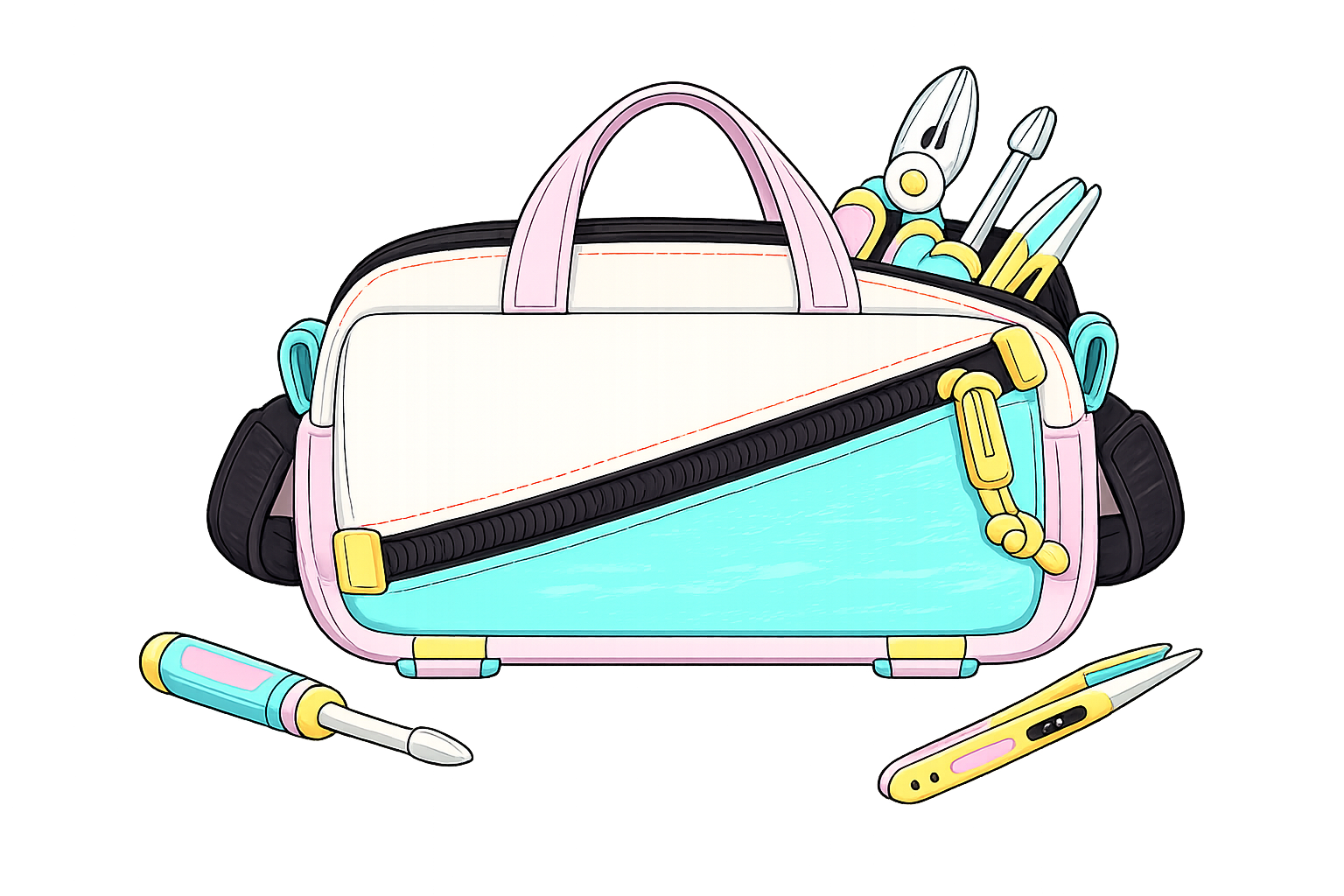
§01 Habits
Best
Practices
The habits that turn "almost" into "done."
Give context up front. Who it's for, the mood you want, two or three apps you love.
Work on a copy and save versions. So you can always roll back to the one that felt right.
Ask for one thing at a time. Stacked requests get muddy; single asks stay sharp.
Be specific with feedback. Point at the exact thing — "the yellow is too pale," not "make it nicer."
Look at every change. Preview it, click around, don't ship blind.
Keep a scrap folder. Screenshots, colors, and snippets you can reuse next time.
Know the last mile. Stuck at 90%? That's normal — bring in a tinker to finish it.
§02 Setup
Settings
for Claude
A quick setup that makes the back-and-forth smoother.
Grab a starter CLAUDE.md →Pick the right model. Use the most capable model for design and tricky logic; a faster one for small edits.
Give it a project file. A short note on what you're building, your taste, and what's off-limits — it stops repeating itself.
Turn on a live preview. Let it open the page and verify changes instead of guessing.
Use plan mode for big moves. Have it propose the approach before it touches anything.
Let it remember your preferences. Voice, colors, conventions — set once, reuse forever.
Review before it goes live. Keep edits visible and approve them; deploy on your say-so.
§03 Shipping
Ship It
for Real
Turn "works on my machine" into something anyone can open.
Start a GitHub repo. Every save becomes a version you can undo — your safety net and your history.
Push changes on a copy, not your live version. Branch each change, test it, merge once it works. If something breaks, you have a working version to fall back to.
Keep a running changelog. A plain list of what changed and when — it becomes your memory of the project and, eventually, your release notes.
Host the front end on Cloudflare Pages or Vercel. Free to start, connects to your repo, publishes on every push.
Add Supabase for anything that needs to remember things. Logins, a database, file storage — no server to babysit.
Point a real domain at it. A five-minute job once you own one.
§04 Reality Check
Know the
Limits
Fast isn't the same as correct, secure, or built to last.
It's easy to ship something that looks done but isn't. The AI optimizes for "this runs," not "this is safe" or "this scales."
Security is the most common blind spot. Exposed API keys, no input validation, wide-open database rules — none of it shows up until someone finds it.
Comments and docs drift from the code fast. If the explanation is doing the work instead of the code being clear, you've inherited debt you can't see.
The last 10% is the hard 10%. A working demo is fast. Holding up under real users and real traffic is a different job.
You won't always know what you don't know. That's the actual boundary of the tool — plan for it instead of hoping around it.
§05 Escalation
Bring In an
Engineer
Not a rewrite — a second set of eyes.
Get a review before anything real is on the line — paying users, personal data, money moving through the app.
Ask them to check: can data leak, will it hold up under load, could another engineer maintain this, does it keep the promises you're making to users.
A good engineer hardens a vibe-coded app in hours, not weeks. You're paying for judgment the AI can't self-check, not a from-scratch build.
Find one on a freelance platform or through your network. This is a common, well-understood job now — not a strange favor to ask.
What does Potchkey mean?
Potchkey means to putter, to fiddle, to tinker — to fuss happily over something until it's just right.
It's the verb for the person who can't leave a thing alone — who keeps tweaking the workflow at midnight, who potchkes with a side project until it finally works exactly right. Less "ship fast," more "get it right and love every minute."
That's exactly what building something you're proud to use feels like. The word made us smile, so we kept it.
- to potchke (v.) — to mess about, tinker, putter, fuss
- a Potchkey — a home for the people who do
Code of Conduct
Everyone's welcome here. Leave your 'tudes at the door.
Potchkey is a place to make useful things and help each other finish them. That only works if it stays kind. So, the house rules:
- Quality has to be on point. This is a place for creators. If it's going on the shelf, make it good — considered, intentional, something people actually want to use. We curate for craft, not clutter.
- Be kind. Critique the work, never the person.
- No gatekeeping. Vibe-coding is coding. Using AI to build is building. Everyone starts somewhere.
- Credit people. Don't pass off someone else's work as yours. Say thanks when a tinker saves your bacon.
- Help when you can. Answer the question, share the trick, leave it better than you found it.
- Make things you'd be proud to show. Beauty is the point.
Break the spirit of this and you're out. Otherwise: welcome in, glad you're here.
Contact
Questions, press, maker inquiries, or just want to talk about software that doesn't make you miserable — we'd love to hear from you.